
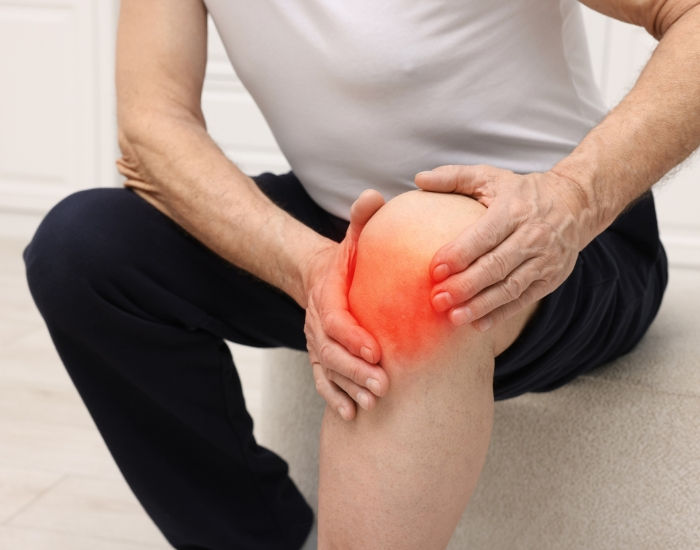
Genicular artery embolization is a minimally invasive procedure used to treat chronic knee pain, particularly in patients with osteoarthritis or other degenerative knee conditions. This technique targets the genicular arteries, which are small blood vessels that supply blood to the knee joint.
Quick Answer: Knee pain from osteoarthritis comes from gradual wear of the cartilage that cushions the joint, combined with inflammation of the joint lining and changes in the bone underneath. It typically causes aching with walking or stairs, stiffness after rest, swelling and a grinding feeling. Most people start with exercise, weight management, physical therapy, pain relievers and injections. When those stop working but surgery is not wanted or not yet needed, genicular artery embolization (GAE) is a minimally invasive option that targets the inflamed blood vessels driving the pain.
During the procedure, a radiologist or interventional radiologist inserts a catheter into the femoral artery, typically through a small incision in the groin area or in the lower ankle. Using X-ray guidance, the catheter is navigated to the genicular arteries in the knee joint. Once in position, tiny particles (100-300 um in size) are injected through the catheter to block or reduce blood flow in the tiny branches of genicular arteries. This process is known as embolization.
By reducing the blood flow to the knee joint, genicular artery embolization aims to decrease inflammation and alleviate pain. The procedure is often performed under local anesthesia and sedation, allowing patients to remain awake but comfortable throughout.
Genicular artery embolization is considered a safer and less invasive alternative to traditional knee surgeries such as total knee replacement or arthroscopy. It offers several potential benefits, including shorter recovery times, lower risk of complications, and preservation of the native knee joint.
Patients who undergo genicular artery embolization typically experience significant relief from knee pain within a few weeks after the procedure. However, individual outcomes may vary, and some patients may require additional treatments or therapies to achieve optimal results.
Like any medical procedure, genicular artery embolization carries some risks, including bleeding, infection, and damage to surrounding tissues. However, these risks are relatively low compared to more invasive surgical interventions.
Overall, genicular artery embolization represents a promising option for patients suffering from chronic knee pain who have not found relief from conservative treatments. As with any medical decision, it’s essential for patients to discuss the potential risks and benefits of the procedure with their healthcare provider to determine if it’s the right choice for them.

Meet your vein specialist
Dr. Syed Raza, MD
Vascular & Interventional Radiology · Founder, Premier Vein & Vascular Center
Fellowship-trained interventional radiologist, board certified in diagnostic and interventional radiology with a Certificate of Added Qualification (CAQ) in interventional radiology, and a Fellow of the Royal College of Radiologists (UK). Member of SIR and RSNA. Former Chief of Interventional Radiology at UTMB Galveston and Memorial Hermann Memorial City, with 15+ years treating varicose veins, venous reflux and peripheral arterial disease.
What Causes Knee Pain From Osteoarthritis?
Osteoarthritis is often described as wear and tear, but that description leaves out the part that matters most for pain. The smooth cartilage covering the ends of the thigh bone and shin bone does thin out over time. Cartilage itself has no nerves, though, so thinning cartilage alone does not explain why the knee hurts.
Pain comes mainly from the tissues around the cartilage. The lining of the joint, called the synovium, becomes inflamed and thickened. The bone just beneath the cartilage takes more load and develops small areas of stress. And the inflamed tissue grows extra small blood vessels, a process called neovascularization. Those new vessels travel alongside new sensory nerve fibers, which makes the joint more sensitive to everyday movement. This is the link between osteoarthritis and the genicular artery embolization procedure described above: reducing the abnormal blood supply to the inflamed lining is meant to calm that cycle.
Common Symptoms of Knee Osteoarthritis
Symptoms usually develop slowly over months or years. In our practice, patients most often describe:
- An aching pain around or inside the knee that is worse with walking, standing, stairs or getting out of a low chair
- Stiffness first thing in the morning or after sitting, which usually loosens within about half an hour
- Swelling or a puffy feeling around the joint, especially after a busy day
- A grinding, creaking or crunching sensation when bending the knee
- Pain along the inner side of the knee, which is the part that often wears first
- Night aching that disturbs sleep in more advanced cases
- Reduced ability to fully straighten or bend the knee
- A sense that the knee is weak or might give way
Symptoms often flare for days or weeks and then settle again. A flare does not necessarily mean the arthritis has suddenly worsened; it often reflects a period of increased inflammation in the joint lining.
Who Develops Knee Osteoarthritis?
Knee osteoarthritis becomes more common with age, but it is not simply an inevitable part of getting older. Factors that raise the risk include:
- Body weight. Every step transmits several times your body weight through the knee, so extra weight increases joint load considerably.
- Previous knee injury, such as a torn meniscus or ligament, even if it happened decades ago.
- Alignment. Bow-legged or knock-kneed alignment concentrates pressure on one side of the joint.
- Repetitive kneeling, squatting or heavy lifting at work.
- Family history and being female, particularly after menopause.
- Weak thigh muscles, which reduce the joint’s shock absorption.
Knee Osteoarthritis Treatment Options Compared
Treatment generally follows a step-by-step approach, starting with the simplest measures and moving on only when they no longer control symptoms. The table summarizes where each option fits.
| Option | What it does | Best suited for | Recovery |
|---|---|---|---|
| Exercise, physical therapy and weight management | Strengthens muscles that support the joint, reduces load | Everyone with knee osteoarthritis, at every stage | None; ongoing commitment |
| Pain relievers and anti-inflammatory medicine | Reduces pain and inflammation during flares | Mild to moderate symptoms, if medically safe for you | None |
| Steroid or other joint injections | Temporarily calms joint inflammation | Flares that do not settle with first-line care | A day or two; relief often temporary |
| Genicular artery embolization (GAE) | Reduces abnormal blood flow to the inflamed joint lining | Mild to moderate osteoarthritis with persistent pain despite conservative care, or people who are not surgical candidates | Usually home the same day; light activity within days |
| Total or partial knee replacement | Replaces the worn joint surfaces | Severe, end-stage arthritis with major loss of function | Weeks to months of rehabilitation |
These options are not mutually exclusive. Exercise and weight management remain valuable even after an injection, GAE or surgery, and GAE does not rule out a knee replacement later if it is ever needed.
Is Genicular Artery Embolization Right for You?
GAE is not meant for every painful knee. It tends to be considered for people who:
- Have knee pain from osteoarthritis that has lasted several months or longer
- Have tried exercise, physical therapy, medication and often injections without lasting relief
- Have mild to moderate arthritis on X-ray, rather than severe bone-on-bone changes, although each case is assessed individually
- Want to avoid or delay knee replacement, or have medical conditions that make major surgery risky
It is usually not suitable when pain comes from a different problem, such as an acute ligament or meniscus tear, an infected joint, or pain referred from the hip or spine. Active infection, significant kidney problems that limit the use of X-ray contrast, and some types of advanced arterial disease may also make it unsuitable. That is why a careful assessment comes first. You can read more about the procedure on our genicular artery embolization page.
Questions worth asking before choosing GAE
Patients who do best with any knee treatment are usually the ones who understand what it can and cannot do. Before deciding, it helps to ask:
- How severe is the arthritis on my X-rays, and is my pain pattern typical of joint inflammation?
- Have I given physical therapy and weight management a fair trial, and what else could still be tried?
- What does recovery look like for someone with my job and activity level?
- How will this fit with my orthopedic surgeon’s plan if I may need a knee replacement in the future?
- Which of my medical conditions or medications need to be managed before the procedure?
We encourage patients to bring their recent knee imaging and a list of the treatments they have already tried. That makes the first visit far more productive and lets us give a specific opinion rather than a general one.
How GAE differs from a joint injection
A steroid injection places medicine directly into the joint space to calm inflammation for a period of time. GAE works from the blood supply instead, reducing the abnormal vessels that feed the inflamed lining. Injections are quick and simple but their effect often wears off; GAE is a procedure with a short recovery that aims for longer-lasting relief. Some patients have had several injections with shorter and shorter benefit before they consider GAE.
How We Evaluate Knee Pain at Premier Vein
Dr. Syed Raza approaches knee pain as an interventional radiologist: the aim is to confirm that osteoarthritis and joint inflammation are the source of pain before recommending any procedure.
- Focused history. We ask where the pain is, what triggers it, how it affects walking, sleep and work, and which treatments you have already tried, including physical therapy, medications and injections.
- Knee examination. We check for swelling, tenderness, range of motion and stability, and examine the hip and circulation in the leg, since hip problems and arterial disease can mimic knee pain.
- Imaging review. Weight-bearing X-rays show the degree of arthritis. MRI may be reviewed or recommended when the cause of pain is unclear, for example to look for a meniscus tear or bone marrow changes.
- A clear plan. We explain whether you are likely to benefit from GAE, what the procedure and recovery involve, the possible risks, and how it fits with your orthopedic care and physical therapy.
What Recovery After GAE Usually Looks Like
Patients often want a practical picture of the days after the procedure. Most go home the same day after a short period of bed rest to protect the small puncture site. It is common to feel some knee aching or tenderness for a few days, which usually responds to simple pain relief and ice. Some people notice temporary skin color changes over the knee that fade on their own.
Light activity such as walking around the home is usually fine within a day or two, and many patients return to desk work within a few days. Pain relief tends to come gradually over the following weeks rather than immediately, as inflammation in the joint lining settles. We usually encourage patients to continue or restart physical therapy once the knee feels comfortable, since stronger muscles help protect the joint over the long term.
Everyday Steps That Help Arthritic Knees
- Keep moving. Low-impact activities like walking, cycling, swimming and water aerobics nourish cartilage and strengthen supporting muscles.
- Strengthen the thighs. Quadriceps and hip exercises reduce the load on the knee; a physical therapist can tailor a program.
- Manage weight. Even modest weight loss reduces knee load and pain for many people.
- Use supportive footwear and consider a cane in the opposite hand during flares.
- Pace activities. Break up long periods of standing and avoid deep squatting or kneeling when the knee is sore.
- Use heat or ice. Heat often eases stiffness; ice can help after activity or during a swollen flare.
Seek urgent medical care if you notice:
- A hot, red, very swollen knee with fever or chills, which may be a joint infection
- Sudden inability to bear weight after a fall or twisting injury
- Swelling, pain and warmth in the calf, which may be a blood clot
- After a GAE procedure: bleeding or a growing lump at the puncture site, or a foot that becomes cold, pale or numb
When to See a Specialist for Knee Pain in Houston
If arthritis pain is limiting your walking, your sleep or your work despite months of conservative care, or if you have been told you are not ready for a knee replacement yet but are struggling now, it is reasonable to ask whether GAE could help. Dr. Syed Raza is a fellowship-trained interventional radiologist and former Chief of Interventional Radiology at UTMB Galveston and Memorial Hermann Memorial City. Our team at Premier Vein & Vascular Center in Houston can review your imaging and history and give you a clear opinion. More information is available on our knee pain treatment page, and you can contact us to request a consultation. Most insurance plans, including Medicare, are accepted, and our staff can check what your plan covers before treatment.
Talk With a Specialist at Premier Vein
Have questions about your symptoms or treatment options? Dr. Syed Raza and the team at Premier Vein & Vascular Center can evaluate your concerns and explain your options clearly. Same-week appointments are usually available, and most insurance plans are accepted.
Frequently Asked Questions
Can knee osteoarthritis pain be reversed?
The cartilage changes of osteoarthritis cannot be reversed, but pain and function can often be improved substantially. Exercise, weight management, physical therapy, injections and, for some patients, genicular artery embolization can all reduce pain without replacing the joint.
Is walking good for knee osteoarthritis?
Yes, for most people. Regular walking at a comfortable pace strengthens the supporting muscles and helps keep the joint mobile. During a flare, shorter walks, supportive shoes or a cane can make it more manageable.
How long does pain relief from GAE last?
Relief usually builds over several weeks after the procedure, and many patients report benefit lasting well beyond that. Results vary between individuals, and some people may need additional treatment later.
Does GAE prevent a future knee replacement?
GAE treats pain from inflammation rather than rebuilding the joint, so it does not stop osteoarthritis from progressing. It can help some people delay surgery, and it does not prevent a knee replacement later if one becomes necessary.
What kind of doctor performs genicular artery embolization?
GAE is performed by interventional radiologists, physicians who specialize in image-guided procedures through the blood vessels. They often work alongside orthopedic surgeons, primary care doctors and physical therapists.
Is knee osteoarthritis pain worse at night?
It can be, especially in more advanced arthritis, when inflammation and pressure in the bone cause aching at rest. Night pain that is severe, comes with fever or follows an injury should be checked promptly.
Can I have GAE if I have had knee injections?
Yes. Many patients who are evaluated for GAE have already had steroid or other injections. Your doctor will usually ask about the timing of your most recent injection and how long its effect lasted when planning treatment.
ABOUT PREMIER VEIN & VASCULAR CENTER: Premier Vein & Vascular Center, a leading vein clinic in Houston and among the top specialized vein treatment clinics in the USA, has provided expert vein care for over 20 years. The center offers minimally invasive treatments for varicose veins, spider veins, and deep vein thrombosis, led by Dr. Syed Raza, MD, a Board-Certified Vein Specialist and Interventional Radiologist. Dedicated to pain-free, healthier living, the clinic delivers cutting-edge, patient-centered care for optimal results.
Trusted Health Resources
- Osteoarthritis, National Institute of Arthritis and Musculoskeletal and Skin Diseases (NIH)
- Osteoarthritis, Centers for Disease Control and Prevention