
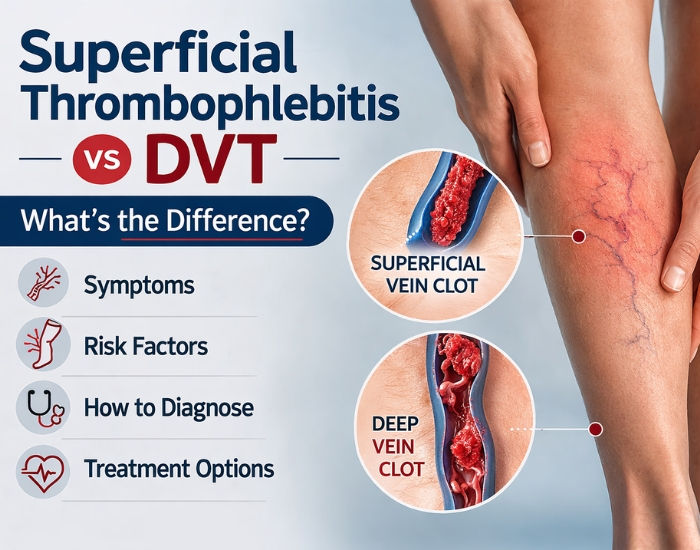
Noticing swelling, redness, or a tender vein in the leg can be concerning. Many people worry about whether the issue is minor or potentially life-threatening. The terms superficial thrombophlebitis and deep vein thrombosis (DVT) often come up in these situations, but it can be confusing to understand the differences. Knowing the signs, risks, and when to seek care is essential for protecting your leg health and overall well-being.
Quick Answer: Superficial thrombophlebitis is a clot in a vein just under the skin, usually a varicose vein, causing a red, warm, tender cord that is uncomfortable but rarely dangerous. Deep vein thrombosis (DVT) is a clot in a deep vein inside the muscles, often causing swelling and pain of the whole calf or leg, and it can travel to the lungs as a pulmonary embolism. The two can occur together, so any suspected leg clot should be checked with a duplex ultrasound. Sudden shortness of breath or chest pain needs a 911 call.
Understanding the distinction between a superficial vein clot and a deep vein clot helps patients make informed decisions about treatment and ensures timely medical attention. This guide breaks down the differences in simple terms, explains symptoms, outlines evaluation methods, and highlights how a vein specialist can help.

Meet your vein specialist
Dr. Syed Raza, MD
Vascular & Interventional Radiology · Founder, Premier Vein & Vascular Center
Fellowship-trained interventional radiologist certified by the American Board of Radiology and the Royal College of Radiologists (UK). Former Chief of Interventional Radiology at UTMB Galveston and Memorial Hermann Memorial City, with 15+ years treating varicose veins, venous reflux and peripheral arterial disease.
What Is Superficial Thrombophlebitis?
Superficial thrombophlebitis occurs when a blood clot forms in a vein near the surface of the skin. This condition often affects the legs and can cause localized pain, redness, and firmness along the affected vein. Although it is usually less serious than DVT, it can still be uncomfortable and occasionally progress to more serious complications if left untreated.
Common Superficial Vein Clot Symptoms
-
Pain or tenderness along the course of the vein
-
Redness and warmth over the affected area
-
A firm, cord-like structure palpable under the skin
-
Mild swelling surrounding the vein
-
Itching or irritation near the clot
Because these symptoms are often visible and localized, superficial thrombophlebitis is typically easier to identify than a deep vein clot. However, professional evaluation is still recommended to rule out extension into deeper veins.
What Is Deep Vein Thrombosis (DVT)?
Deep vein thrombosis (DVT) occurs when a blood clot forms in the deeper veins of the body, usually in the legs. Unlike superficial clots, DVT can be more dangerous because the clot may travel to the lungs and cause a pulmonary embolism, a life-threatening condition.
Deep Vein Thrombosis Signs
-
Swelling in one leg (often sudden and significant)
-
Pain or tenderness, especially in the calf
-
Warmth and redness over the affected area
-
Skin discoloration or a bluish tint
-
Veins that appear normal on the surface (clot is deep)
Since DVT may develop without obvious surface signs, it can be more difficult for patients to recognize. Prompt evaluation by a vein specialist is critical for diagnosis and treatment.
Key Differences Between Superficial Thrombophlebitis and DVT
Understanding the difference between superficial thrombophlebitis vs DVT is vital because treatment approaches and risks vary significantly.
-
Location:
-
Superficial Thrombophlebitis: Veins near the skin surface
-
Deep Vein Thrombosis (DVT): Deep veins within the muscles
-
-
Risk:
-
Superficial Thrombophlebitis: Usually lower risk, rarely life-threatening
-
DVT: Higher risk, can lead to pulmonary embolism
-
-
Pain:
-
Superficial Thrombophlebitis: Localized, along a visible vein
-
DVT: Often diffuse, may involve the entire leg
-
-
Swelling:
-
Superficial Thrombophlebitis: Mild and localized
-
DVT: Significant, can involve the entire leg
-
-
Redness/Warmth:
-
Superficial Thrombophlebitis: Common and noticeable
-
DVT: May occur but less visible
-
-
Treatment:
-
Superficial Thrombophlebitis: Compression, elevation, anti-inflammatory medications
-
DVT: Anticoagulants, monitoring, sometimes hospitalization
-
-
Clot Visibility:
-
Superficial Thrombophlebitis: Cord-like vein may be visible under the skin
-
DVT: Usually not visible on the surface
-
Recognizing these distinctions helps patients determine when urgent care is necessary versus when home monitoring may be appropriate.
Causes and Risk Factors
Both conditions share some risk factors, though DVT generally involves higher-risk situations.
Common Causes of Superficial Thrombophlebitis
-
Varicose veins or vein inflammation
-
Minor injury or trauma to a superficial vein
-
Extended periods of inactivity or sitting
-
Certain medications, such as hormone therapy or birth control
Common Causes of Deep Vein Thrombosis
-
Prolonged immobility (long flights, bed rest)
-
Recent surgery or hospitalization
-
Cancer or chemotherapy
-
Genetic clotting disorders
-
Obesity or smoking
While both superficial and deep vein clots involve the coagulation system, DVT carries a higher risk of serious complications, making early recognition essential.
Symptoms to Watch For
Knowing superficial vein clot symptoms versus deep vein thrombosis signs helps patients take appropriate action.
Superficial Vein Clot Symptoms:
-
Pain or tenderness along a visible vein
-
Firm, rope-like texture under the skin
-
Redness and warmth
-
Mild localized swelling
Deep Vein Thrombosis Signs:
-
Sudden or increasing swelling in one leg
-
Diffuse pain, especially in the calf
-
Warmth or redness that may cover a larger area
-
Skin that appears bluish or discolored
-
Rarely, shortness of breath if a clot moves to the lungs
Recognizing these differences is crucial because DVT requires immediate medical evaluation, while superficial clots often respond to conservative treatment.
When to Seek Medical Attention
Even though superficial thrombophlebitis is often less severe, patients should consult a vein specialist in Houston if:
-
Pain, swelling, or redness worsens over a few days
-
There is any suspicion the clot may involve deeper veins
-
Symptoms include fever, chills, or systemic discomfort
For DVT, urgent care is needed if there are:
-
Significant leg swelling or sudden onset of pain
-
Warmth or redness affecting the entire leg
-
Shortness of breath or chest pain (possible pulmonary embolism)
Early evaluation by a vein specialist ensures accurate diagnosis, targeted treatment, and prevention of complications.
How Vein Specialists Diagnose Clots
A vein specialist can distinguish superficial thrombophlebitis vs DVT using a combination of history, examination, and advanced testing.
1: Medical History
-
Recent surgery, trauma, or immobility
-
Family history of clotting disorders
-
Medications or hormone therapy
-
Previous vein problems
2: Physical Examination
-
Checking for visible vein changes
-
Measuring leg circumference
-
Assessing tenderness, warmth, and redness
3: Diagnostic Tests
-
Doppler Ultrasound: Detects clots in superficial and deep veins
-
Blood tests: Check for clotting disorders or infection
-
Imaging: CT or MRI may be used for complex or unclear cases
Treatment Approaches
Treatment differs significantly between superficial thrombophlebitis and DVT.
Superficial Thrombophlebitis Treatment
-
Elevation of the affected leg
-
Compression therapy to improve blood flow
-
Anti-inflammatory medications for pain and swelling
-
Avoiding prolonged inactivity
-
In some cases, minimally invasive procedures for varicose veins
DVT Treatment
-
Anticoagulants (blood thinners) to prevent clot growth
-
Monitoring for clot migration or pulmonary embolism
-
Compression stockings to reduce swelling and improve circulation
-
Lifestyle adjustments to prevent recurrence
-
In severe cases, hospitalization or surgical intervention
Lifestyle Measures to Support Vein Health
Regardless of clot type, certain lifestyle measures help improve circulation and prevent recurrence:
-
Stay active with walking or low-impact exercise
-
Avoid prolonged sitting or standing
-
Elevate legs when resting
-
Maintain healthy weight and diet
-
Avoid smoking, which damages veins
These steps complement medical treatment and promote long-term vascular health.
Preventing Future Clots
Prevention strategies vary depending on risk factors:
-
Patients prone to superficial thrombophlebitis: manage varicose veins, use compression, and stay mobile
-
DVT prevention: avoid extended immobility, follow post-surgical recommendations, and consider prophylactic anticoagulants if high-risk
Education and early action are key to preventing both superficial and deep vein clots.
Why the Location and Length of a Superficial Clot Matter
Not every superficial vein clot is treated the same way. When we scan a patient with superficial thrombophlebitis, we measure how long the clot is and how close it comes to the point where the surface vein joins the deep system. Those two measurements, more than how red or painful the leg looks, determine the risk and the treatment.
| Ultrasound finding | What it means | Typical management |
|---|---|---|
| Short clot in a branch varicose vein, well away from the deep veins | Low risk of spreading to the deep system | Walking, compression, warm compresses and anti-inflammatory medicine if safe for you, with follow-up |
| Longer clot (about 5 cm or more) in a main surface vein | Higher chance of extension or a deep clot | A short course of low-dose blood thinner is often recommended under current guidelines |
| Clot within a few centimeters of the groin or knee junction | Close to the deep veins, behaving more like a DVT | Usually treated with full-dose anticoagulation |
| Superficial clot plus a clot in a deep vein | DVT is present | Treated as DVT with anticoagulation |
This is why we never rely on appearance alone. A small, sore vein on the calf can look reassuring while the clot inside it extends much higher than the visible redness suggests.
Superficial Clots in Varicose Veins vs Normal-Looking Veins
Most superficial thrombophlebitis happens in varicose veins, where slow, pooling blood makes clotting more likely. In that setting, the main underlying problem is usually venous insufficiency.
A clot in a surface vein that is not varicose, or clots that keep appearing in different places without a clear trigger, are less common. Doctors sometimes look further in these situations, for example checking for an inherited clotting tendency or making sure age-appropriate cancer screening is up to date. This is not cause for alarm, just a reason to discuss your history carefully with your doctor.
Arm vein clots after an IV
Superficial thrombophlebitis also commonly occurs in the arm after an IV line or blood draw. It usually settles with warm compresses and time once the line is removed. Clots in the deep veins of the arm are different and are more often linked to central lines, ports or dialysis catheters, and they need proper evaluation.
Recognizing a Pulmonary Embolism
The main danger of DVT is that part of the clot breaks off and travels to the lungs. A pulmonary embolism can happen with very few leg symptoms, so it is important to know its signs.
Call 911 immediately if you have:
- Sudden shortness of breath, or breathing that becomes fast and difficult
- Sharp chest pain that is worse when you take a deep breath or cough
- Coughing up blood
- A racing heartbeat, lightheadedness or fainting
- Sudden swelling, pain and warmth in one leg together with any of the above
How We Evaluate a Suspected Leg Clot at Premier Vein
When a patient comes to us with a painful vein or a swollen leg, the goal is a fast, clear answer.
- Focused history. We ask when the symptoms started, about recent surgery, travel, injury, hormone use, pregnancy, cancer, previous clots and family history of clotting.
- Examination. We trace the tender vein, look for swelling and compare the size of both legs, check the skin and pulses, and note any varicose veins.
- Venous duplex ultrasound. In our IAC-accredited vascular lab, we scan both the superficial and deep veins, measure the clot’s length and its distance from the deep system, and check for any deep clot. You can learn more on our venous ultrasound page.
- A clear plan. We explain whether the clot is superficial, deep or both, what treatment is needed, how long it will last and when to recheck. If you need anticoagulation, we coordinate with your primary care doctor.
After the Clot: Treating the Veins That Caused It
When superficial thrombophlebitis happens in a varicose vein, the vein that clotted, and the reflux feeding it, are still there once the inflammation settles. Without treatment, the same area can clot again. Once the acute episode has calmed down, usually after several weeks, we re-scan the leg and discuss closing the faulty vein with endovenous thermal ablation or non-thermal techniques, and treating remaining branches. These are office procedures done under local anesthesia, with most patients walking out the same day.
Life after a DVT
Some people develop lasting leg aching, swelling and skin changes months or years after a DVT, because the clot scarred the deep vein valves. This is called post-thrombotic syndrome. Staying active, wearing compression as advised and having swelling or skin changes evaluated early all help. Our deep vein thrombosis page explains our approach to DVT care in more detail.
When to See a Vein Specialist in Houston
A tender, red cord along a vein, new swelling in one leg or a history of clots with ongoing leg symptoms all deserve an ultrasound, ideally within a day or two, and immediately if symptoms are severe. Our Houston vein specialist, Dr. Syed Raza, is a fellowship-trained interventional radiologist with more than 15 years of experience treating venous disease. Patients from Houston, Katy and nearby communities can usually be seen the same week, and most insurance plans, including Medicare, are accepted. For emergency symptoms such as chest pain or shortness of breath, call 911 first.
Talk With a Specialist at Premier Vein
Have questions about your symptoms or treatment options? Dr. Syed Raza and the team at Premier Vein & Vascular Center can evaluate your concerns and explain your options clearly. Same-week appointments are usually available, and most insurance plans are accepted.
FAQs About Superficial Thrombophlebitis vs DVT
1. How can I tell the difference between DVT and thrombophlebitis?
DVT affects deeper veins and may cause widespread swelling, whereas superficial thrombophlebitis is visible, localized, and typically less dangerous.
2. Are superficial clots dangerous?
Most superficial clots are not life-threatening, but they can occasionally extend to deeper veins, so evaluation is important.
3. What should I do if I notice a tender vein in my leg?
Monitor symptoms, and seek evaluation if swelling, redness, or pain worsens, or if DVT signs appear.
4. Can lifestyle changes prevent vein clots?
Yes. Staying active, wearing compression stockings, and avoiding prolonged sitting help reduce risk.
5. When should I see a vein specialist in Houston?
Any persistent swelling, redness, or tenderness should prompt consultation with a local vein expert to ensure accurate diagnosis and treatment.
Final Thoughts
Understanding superficial thrombophlebitis vs DVT is crucial because the two conditions differ in severity, risk, and treatment. Recognizing symptoms early, knowing the risk factors, and seeking timely evaluation can prevent complications and improve outcomes.
A vein specialist in Houston can provide expert assessment, advanced imaging, and tailored treatment plans for both superficial and deep vein clots. By consulting a local vein expert, patients gain peace of mind, accurate diagnosis, and effective care for long-term leg and vascular health.
Can I walk with superficial thrombophlebitis?
Yes. Walking is encouraged because it keeps blood moving through the deep veins and helps the inflammation settle. Bed rest is generally not recommended unless your doctor advises it.
How long does superficial thrombophlebitis last?
The pain and redness usually improve over one to two weeks, while the firm lump in the vein can take several weeks or longer to soften. If symptoms worsen or spread instead of improving, have the leg rechecked with an ultrasound.
Do I need blood thinners for a superficial vein clot?
Not always. Short clots in branch veins are often managed with compression, walking and anti-inflammatory medicine. Longer clots or those close to the deep veins are often treated with a blood thinner, which is why an ultrasound is important.
Should I use heat or ice on a superficial vein clot?
Warm compresses are usually recommended for superficial thrombophlebitis because they ease pain and inflammation. Do not massage the vein firmly, and seek care if redness spreads or you develop fever.
How long does it take for a DVT to dissolve?
Blood thinners stop a DVT from growing while the body gradually breaks the clot down, a process that typically takes weeks to months. Treatment usually continues for at least three months, depending on the cause and your risk factors.
Can you have a DVT without swelling?
Yes. Some DVTs cause only mild calf pain or tenderness, and some cause no leg symptoms at all. That is why risk factors such as recent surgery or long travel matter, and why an ultrasound is the reliable way to diagnose it.
Trusted Health Resources
- Venous Thromboembolism, National Heart, Lung, and Blood Institute (NIH)
- About Venous Thromboembolism (Blood Clots), Centers for Disease Control and Prevention
Medical Disclaimer: This content is for educational purposes only and does not replace professional medical advice. Always consult a qualified healthcare provider for personalized diagnosis and treatment.